
Star-forming ring fueling AGN in the galaxy NGC 5347
- 1 Sternberg Astronomical Institute of the Lomonosov Moscow State University, University av. 13, Moscow, 119234 Russia
- 2 Special Astrophysical Observatory of the Russian Academy of Sciences, Nizhnij Arkhyz, 369167 Russia
Abstract
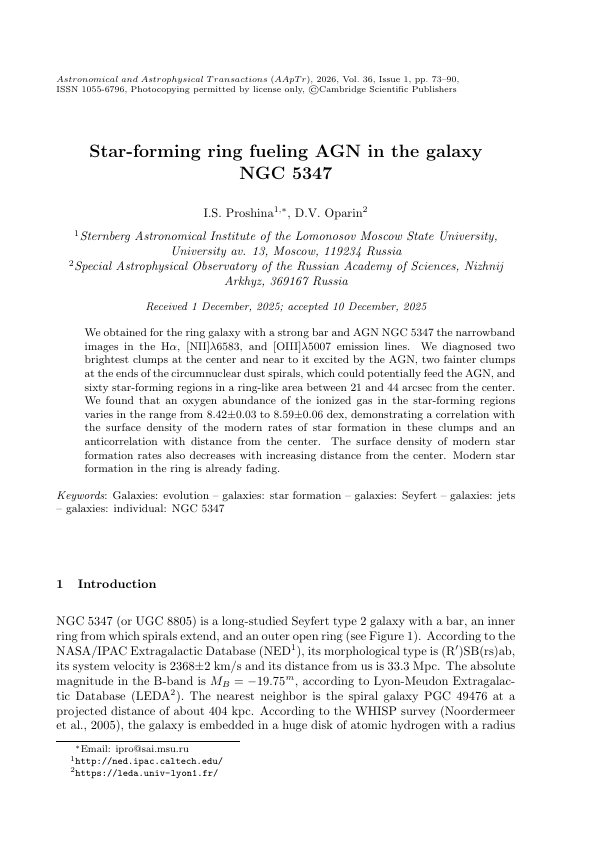
We obtained for the ring galaxy with a strong bar and AGN NGC 5347 the narrowband images in the Hα, [NII] λ6583, and [OIII]λ5007 emission lines. We diagnosed two brightest clumps at the center and near to it excited by the AGN, two fainter clumps at the ends of the circumnuclear dust spirals, which could potentially feed the AGN, and sixty star-forming regions in a ring-like area between 21 and 44 arcsec from the center. We found that an oxygen abundance of the ionized gas in the star-forming regions varies in the range from 8.42 ±0.03 to 8.59 ±0.06 dex, demonstrating a correlation with the surface density of the modern rates of star formation in these clumps and an anticorrelation with distance from the center. The surface density of modern star formation rates also decreases with increasing distance from the center. Modern star formation in the ring is already fading.
Read the article
PDF of 18 pages, as printed in the journal, pages 73 to 90. Open access.
Read the PDF