
On the relation of the Universe mass to a strong gravitational constant decay
Summary
Microphysics is related to cosmology. The Big Bang corresponds to the decay of the unified physical interaction and the decrease of gravitation by 10 to the power of 40.67. The metagalaxy space curvature radius was growing by the same value: from 10<sup>-13</sup> cm to 10<sup>28</sup> cm. The mass of Universe matter 2.10<sup>56</sup> g was growing from the Planck mass by 10 to the power of 61. The total mass with the negative potential mass-energy was zero before and after the Big Bang.
Abstract
Microphysics is related to cosmology. The Big Bang corresponds to the decay of the unified physical interaction and the decrease of gravitation by 10 to the power of 40.67. The metagalaxy space curvature radius was growing by the same value: from 10<sup>-13</sup> cm to 10<sup>28</sup> cm. The mass of Universe matter 2.10<sup>56</sup> g was growing from the Planck mass by 10 to the power of 61. The total mass with the negative potential mass-energy was zero before and after the Big Bang.
Read the article
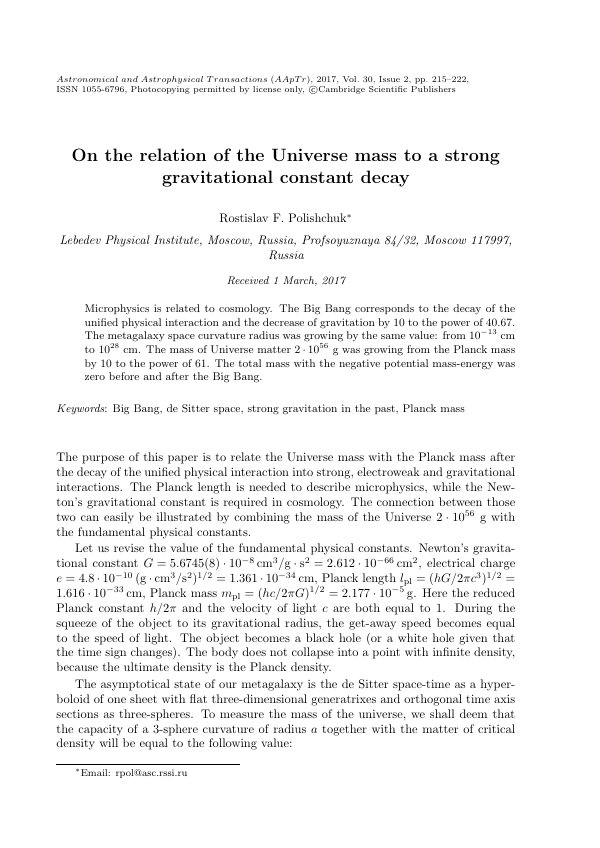
PDF of 8 pages, as printed in the journal, pages 215 to 222. Open access.
Read the PDF