
Toward the birth of very wide binary stars
Summary
During initial (quasi-isothermal) collapse stage of protostellar clouds the magnetosonic pulsations become gravitationally unstable when density increases at 2-3 orders of magnitude. If the region of such density has supercritical ratio of rotational to gravitational energies: ε<sub>rot</sub> ≥ 0.14-0.27, then fragmentation occurs. Such early fragmentation causes a large separation between protostars and can be formation mechanism of wide binary or multiple stars. The rotation of cloud central region is the superposition of cloud rotation and turbulent motion. If these motions are codirectional then supercritical values of ε<sub>rot</sub> are more probable, otherwise - less probable. During 3D MHD simulations we found the cases when only 1/7 of realizations of initial turbulence lead to early fragmentation. In some cases the ratio of fragments separation <I>d</I> to initial cloud radius can achieve 0.4 that corresponds to very wide binaries: <I>d</I> ≈ 10<sup>3</sup>3-10<sup>4</sup> AU.
Abstract
During initial (quasi-isothermal) collapse stage of protostellar clouds the magnetosonic pulsations become gravitationally unstable when density increases at 2-3 orders of magnitude. If the region of such density has supercritical ratio of rotational to gravitational energies: ε<sub>rot</sub> ≥ 0.14-0.27, then fragmentation occurs. Such early fragmentation causes a large separation between protostars and can be formation mechanism of wide binary or multiple stars. The rotation of cloud central region is the superposition of cloud rotation and turbulent motion. If these motions are codirectional then supercritical values of ε<sub>rot</sub> are more probable, otherwise - less probable. During 3D MHD simulations we found the cases when only 1/7 of realizations of initial turbulence lead to early fragmentation. In some cases the ratio of fragments separation <I>d</I> to initial cloud radius can achieve 0.4 that corresponds to very wide binaries: <I>d</I> ≈ 10<sup>3</sup>3-10<sup>4</sup> AU.
Read the article
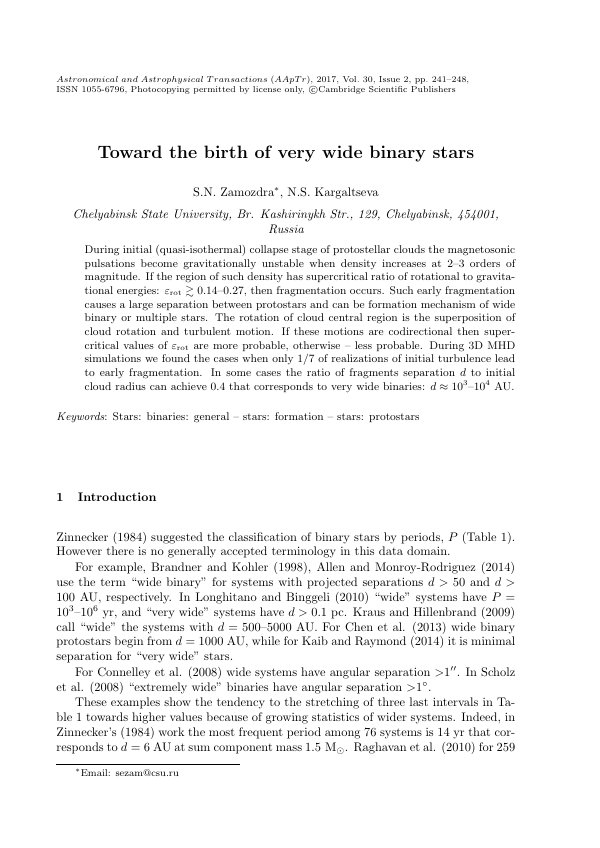
PDF of 8 pages, as printed in the journal, pages 241 to 248. Open access.
Read the PDF