
Lithium, sodium and potassium resonance lines pressure broadened by helium atoms
Summary
The resonance lines of alkali-metal atoms, broadened by collisions with helium atoms,
are prominent features in the spectra of brown dwarfs. We carried out calculations of the emission and absorption spectra in the far red and blue wings of the first resonant doublets of lithium, sodium and potassium perturbed by helium atoms, for temperatures from 500 to 3000 K. For our calculation we used carefully constructed electronic adiabatic potential energy curves and electronic transition dipole moments of Li-He, Na-He and K-He molecules. In the computation of the emission and absorption coefficients, we used the fully quantum-mechanical calculation, based on the Fourier grid
Hamiltonian method. The obtained absorption and emission spectra are compared with previous theoretical calculations.
Abstract
The resonance lines of alkali-metal atoms, broadened by collisions with helium atoms,
are prominent features in the spectra of brown dwarfs. We carried out calculations of the emission and absorption spectra in the far red and blue wings of the first resonant doublets of lithium, sodium and potassium perturbed by helium atoms, for temperatures from 500 to 3000 K. For our calculation we used carefully constructed electronic adiabatic potential energy curves and electronic transition dipole moments of Li-He, Na-He and K-He molecules. In the computation of the emission and absorption coefficients, we used the fully quantum-mechanical calculation, based on the Fourier grid
Hamiltonian method. The obtained absorption and emission spectra are compared with previous theoretical calculations.
Read the article
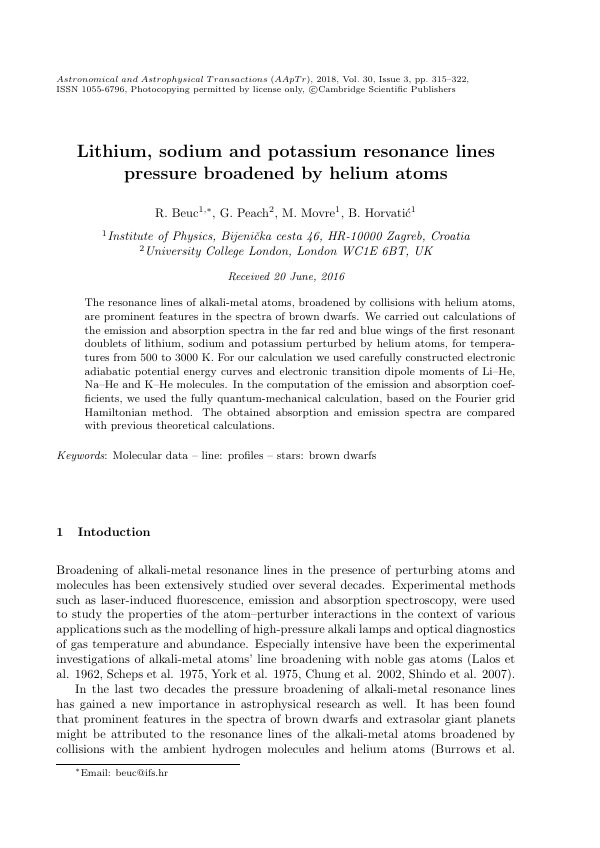
PDF of 8 pages, as printed in the journal, pages 315 to 322. Open access.
Read the PDF