
Fluctuating governing parameters in galaxy dynamo
Summary
Evolution of galaxy magnetic fields is described by the so-called dynamo theory. The equations include governing parameters that describe alpha-effect, differential rotation and turbulent diffusion. Usually these coefficients are connected with average kinematic
characteristics of the interstellar medium. This approach is possible for "calm" galaxies. However, if there is intensive star formation, supernova explosions and other active processes, the parameters of the interstellar gas change. The distribution of the regions
where the velocities of the interstellar medium are different is quite random. So it is useful to use the model of the galaxy dynamo with random coefficients. Previous
papers described fluctuating alpha-effect, but it is necessary to take into account the turbulent diffusion, too. We use the so-called no-z approximation to study the magnetic field. It takes into account that the galaxy disc is thin, so the z-derivatives can be changed by algebraic expressions. We describe the fluctuations of turbulent diffusion coefficients. We have shown that the magnetic field can be changed a lot even for quite small fluctuations of the dynamo governing parameters (associated with weak star formation). For example, the star formation that is several times higher than in the Milky Way can destroy the regular magnetic field.
Abstract
Evolution of galaxy magnetic fields is described by the so-called dynamo theory. The equations include governing parameters that describe alpha-effect, differential rotation and turbulent diffusion. Usually these coefficients are connected with average kinematic
characteristics of the interstellar medium. This approach is possible for "calm" galaxies. However, if there is intensive star formation, supernova explosions and other active processes, the parameters of the interstellar gas change. The distribution of the regions
where the velocities of the interstellar medium are different is quite random. So it is useful to use the model of the galaxy dynamo with random coefficients. Previous
papers described fluctuating alpha-effect, but it is necessary to take into account the turbulent diffusion, too. We use the so-called no-z approximation to study the magnetic field. It takes into account that the galaxy disc is thin, so the z-derivatives can be changed by algebraic expressions. We describe the fluctuations of turbulent diffusion coefficients. We have shown that the magnetic field can be changed a lot even for quite small fluctuations of the dynamo governing parameters (associated with weak star formation). For example, the star formation that is several times higher than in the Milky Way can destroy the regular magnetic field.
Read the article
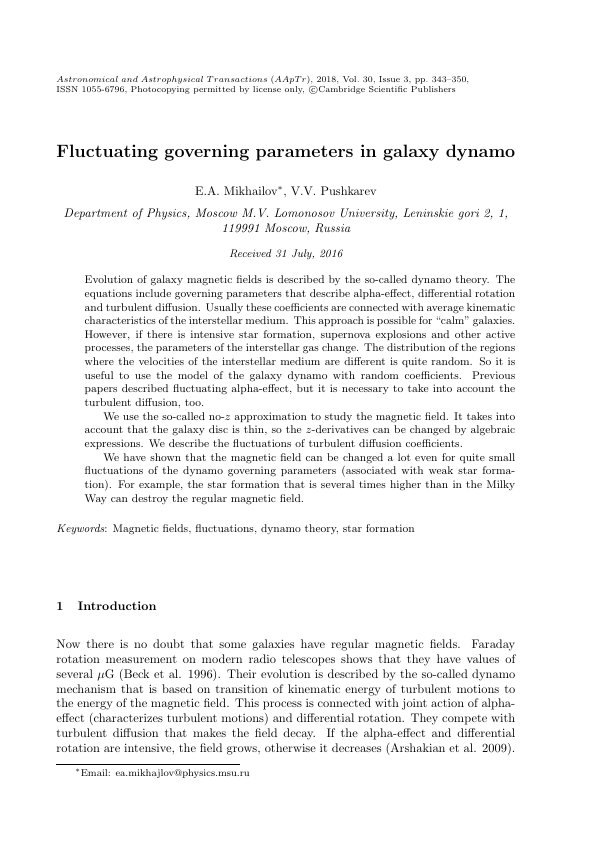
PDF of 8 pages, as printed in the journal, pages 343 to 350. Open access.
Read the PDF