
Diagnostic complex of solar activity based on small radiotelescopes of the Sun service KRIM
Summary
The radio astronomical diagnostic complex of solar activity, created on the basis of the radio telescope RT-22 and three small radio telescopes united in the Sun Service KRIM located in coordinates longitude 33 59' 30" latitude 44 23' 52", conducts simultaneous observations in the wavelength range from 8 mm to 1.2 m in the monitoring mode and alerts. The Sun Service KRIM registered a series of strong outbreaks in the Sun in September 2017, when it was at a minimum of its activity. The information obtained by radio telescopes correlates well with data from other terrestrial and satellite observatories such as RSTN and GOES. Correlation coefficients are calculated and scattering diagrams for X-ray class flares 9.3 and 2.2 are constructed. The information from the radio telescopes of the Sun Service KRIM allows them to be used for daily monitoring of solar activity, further processing of data obtained in the course of scientific research, short-term forecast of space weather and analysis of its influence on the Earth.
Abstract
The radio astronomical diagnostic complex of solar activity, created on the basis of the radio telescope RT-22 and three small radio telescopes united in the Sun Service KRIM located in coordinates longitude 33 59' 30" latitude 44 23' 52", conducts simultaneous observations in the wavelength range from 8 mm to 1.2 m in the monitoring mode and alerts. The Sun Service KRIM registered a series of strong outbreaks in the Sun in September 2017, when it was at a minimum of its activity. The information obtained by radio telescopes correlates well with data from other terrestrial and satellite observatories such as RSTN and GOES. Correlation coefficients are calculated and scattering diagrams for X-ray class flares 9.3 and 2.2 are constructed. The information from the radio telescopes of the Sun Service KRIM allows them to be used for daily monitoring of solar activity, further processing of data obtained in the course of scientific research, short-term forecast of space weather and analysis of its influence on the Earth.
Read the article
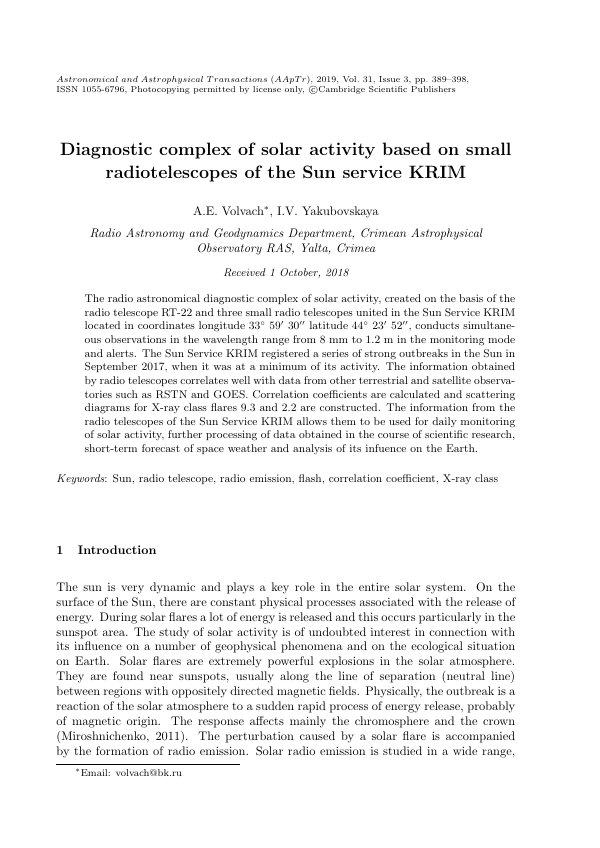
PDF of 10 pages, as printed in the journal, pages 389 to 398. Open access.
Read the PDF