
Three kinematical methods to identify local Galactic structures
Summary
<I>Method one</I>: by combining a sampling parameter related to an isolating integral of the stellar motion, an optimisation of the mixture approach, and a maximisation of the partition entropy for the constituent populations of the stellar sample. <I>Method two</I>: by segregating into different kinematical components in terms of the stellar orbital parameters. <I>Method three</I>: by approaching a maximum entropy velocity distribution to samples selected in terms of stellar eccentricity layers. <I>Working samples</I>: HIPPARCOS and Geneva-Copenhagen survey catalog. <I>Results</I>: kinematical characterisation of largescale structures, such as thin disc, thick disc and halo, and identification of smallscale structures, such as moving groups in the solar neighbourhood. <I>Consequences</I>: confirmation of the Titius–Bode-like law for radial velocity dispersions and explanation of the apparent vertex deviation of the disc from the swinging of two major kinematic groups around the LSR, by predicting a continuously changing orientation of the disc pseudo ellipsoid.
Abstract
<I>Method one</I>: by combining a sampling parameter related to an isolating integral of the stellar motion, an optimisation of the mixture approach, and a maximisation of the partition entropy for the constituent populations of the stellar sample. <I>Method two</I>: by segregating into different kinematical components in terms of the stellar orbital parameters. <I>Method three</I>: by approaching a maximum entropy velocity distribution to samples selected in terms of stellar eccentricity layers. <I>Working samples</I>: HIPPARCOS and Geneva-Copenhagen survey catalog. <I>Results</I>: kinematical characterisation of largescale structures, such as thin disc, thick disc and halo, and identification of smallscale structures, such as moving groups in the solar neighbourhood. <I>Consequences</I>: confirmation of the Titius–Bode-like law for radial velocity dispersions and explanation of the apparent vertex deviation of the disc from the swinging of two major kinematic groups around the LSR, by predicting a continuously changing orientation of the disc pseudo ellipsoid.
Read the article
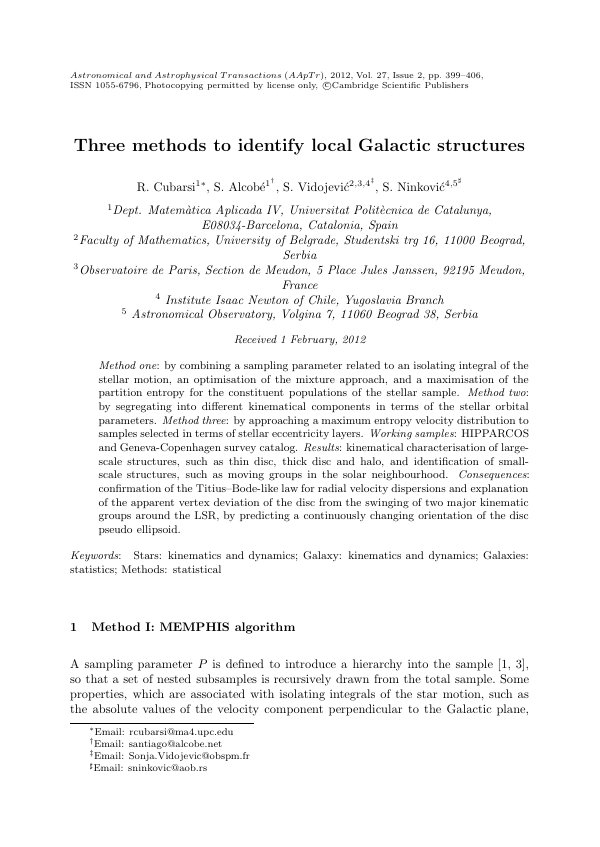
PDF of 8 pages, as printed in the journal, pages 399 to 405. Open access.
Read the PDF