
Tidal evolution of close eclipsing binaries
Summary
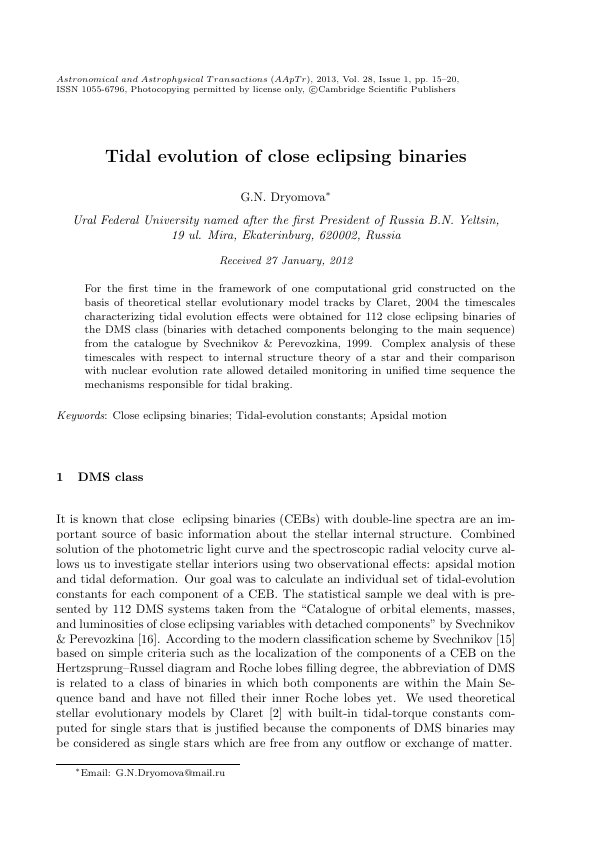
For the first time in the framework of one computational grid constructed on the basis of theoretical stellar evolutionary model tracks by Claret, 2004 the timescales characterizing tidal evolution effects were obtained for 112 close eclipsing binaries of the DMS class (binaries with detached components belonging to the main sequence) from the catalogue by Svechnikov & Perevozkina, 1999. Complex analysis of these timescales with respect to internal structure theory of a star and their comparison with nuclear evolution rate allowed detailed monitoring in unified time sequence the mechanisms responsible for tidal braking.
Abstract
For the first time in the framework of one computational grid constructed on the basis of theoretical stellar evolutionary model tracks by Claret, 2004 the timescales characterizing tidal evolution effects were obtained for 112 close eclipsing binaries of the DMS class (binaries with detached components belonging to the main sequence) from the catalogue by Svechnikov & Perevozkina, 1999. Complex analysis of these timescales with respect to internal structure theory of a star and their comparison with nuclear evolution rate allowed detailed monitoring in unified time sequence the mechanisms responsible for tidal braking.
Read the article
PDF of 6 pages, as printed in the journal, pages 15 to 20. Open access.
Read the PDF