
How many thick disk subsystems are there in the Milky Way Galaxy?
Summary
It was shown that stellar populations of the Galaxy with the thick disk kinematics, namely globular clusters, field RR Lyrae variables (lyrids), and nearby field F - G stars, have different chemical compositions. Based on the analysis of the nature of the dependencies of [alpha/Fe] on [Fe/H] for these objects, it was concluded that the thick disk subsystem in the Galaxy is composite, and at least three components independently exist inside it. The oldest subsystem consists of the metal-rich globular clusters which were formed from a single protogalactic cloud shortly after onset of the explosions of type Ia supernova in it. Then a subsystem of the field thick disk stars was formed as a result of the "heating" of the stars of the primary thin disk already formed in the Galaxy by a rather massive dwarf satellite galaxy which fell onto the Galaxy. And, finally, the subsystem of field stars (including the lyrids) with the kinematics of not only the thick, but even the thin disk that fell onto the Galaxy from this captured satellite galaxy.
Abstract
It was shown that stellar populations of the Galaxy with the thick disk kinematics, namely globular clusters, field RR Lyrae variables (lyrids), and nearby field F - G stars, have different chemical compositions. Based on the analysis of the nature of the dependencies of [alpha/Fe] on [Fe/H] for these objects, it was concluded that the thick disk subsystem in the Galaxy is composite, and at least three components independently exist inside it. The oldest subsystem consists of the metal-rich globular clusters which were formed from a single protogalactic cloud shortly after onset of the explosions of type Ia supernova in it. Then a subsystem of the field thick disk stars was formed as a result of the "heating" of the stars of the primary thin disk already formed in the Galaxy by a rather massive dwarf satellite galaxy which fell onto the Galaxy. And, finally, the subsystem of field stars (including the lyrids) with the kinematics of not only the thick, but even the thin disk that fell onto the Galaxy from this captured satellite galaxy.
Read the article
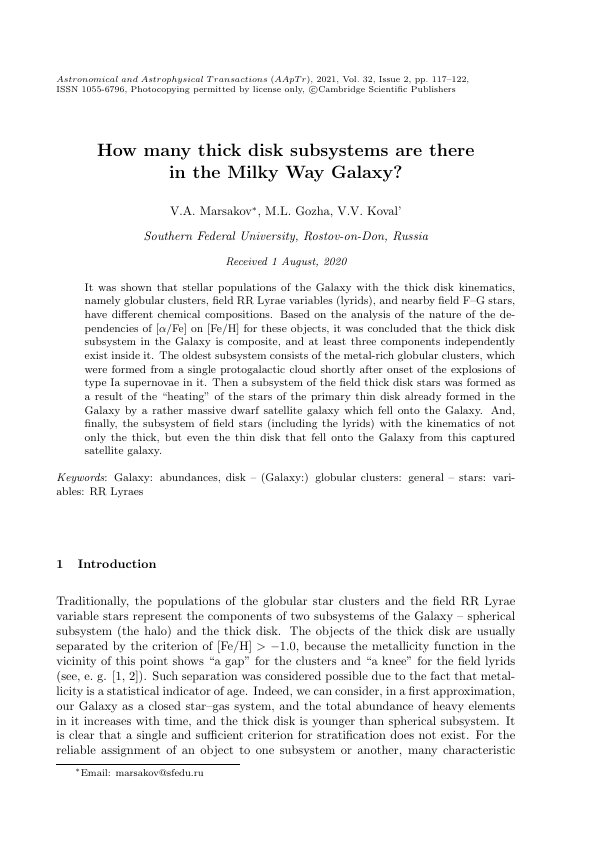
PDF of 6 pages, as printed in the journal, pages 117 to 122. Open access.
Read the PDF