
Physical properties of components in multiple stars and their dynamics
Summary
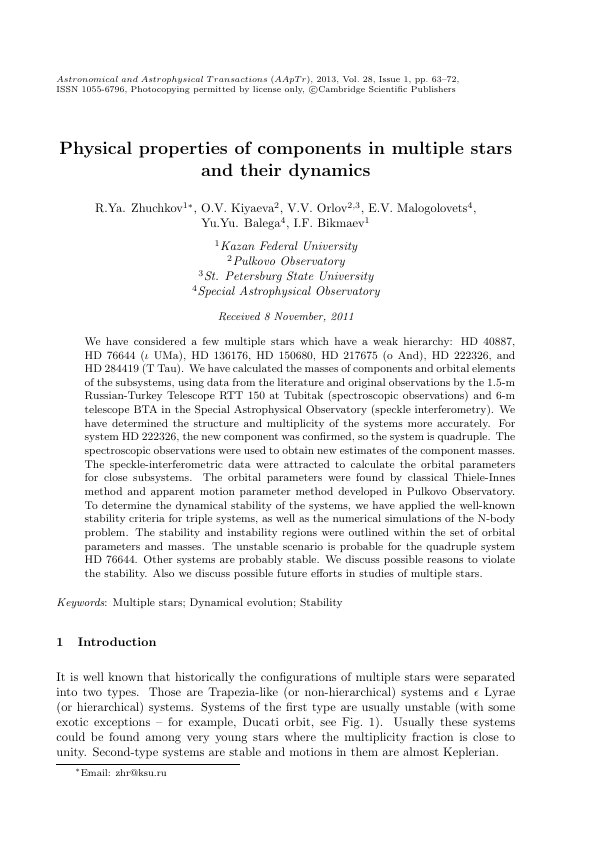
We have considered a few multiple stars which have a weak hierarchy: HD 40887, HD 76644 (ι UMa), HD 136176, HD 150680, HD 217675 (o And), HD 222326, and HD 284419 (T Tau). We have calculated the masses of components and orbital elements of the subsystems, using data from the literature and original observations by the 1.5-m Russian-Turkey Telescope RTT 150 at Tubitak (spectroscopic observations) and 6-m telescope BTA in the Special Astrophysical Observatory (speckle interferometry). We have determined the structure and multiplicity of the systems more accurately. For system HD 222326, the new component was confirmed, so the system is quadruple. The spectroscopic observations were used to obtain new estimates of the component masses. The speckle-interferometric data were attracted to calculate the orbital parameters for close subsystems. The orbital parameters were found by classical Thiele-Innes method and apparent motion parameter method developed in Pulkovo Observatory. To determine the dynamical stability of the systems, we have applied the well-known stability criteria for triple systems, as well as the numerical simulations of the N-body problem. The stability and instability regions were outlined within the set of orbital parameters and masses. The unstable scenario is probable for the quadruple system HD 76644. Other systems are probably stable. We discuss possible reasons to violate the stability. Also we discuss possible future efforts in studies of multiple stars.
Abstract
We have considered a few multiple stars which have a weak hierarchy: HD 40887, HD 76644 (ι UMa), HD 136176, HD 150680, HD 217675 (o And), HD 222326, and HD 284419 (T Tau). We have calculated the masses of components and orbital elements of the subsystems, using data from the literature and original observations by the 1.5-m Russian-Turkey Telescope RTT 150 at Tubitak (spectroscopic observations) and 6-m telescope BTA in the Special Astrophysical Observatory (speckle interferometry). We have determined the structure and multiplicity of the systems more accurately. For system HD 222326, the new component was confirmed, so the system is quadruple. The spectroscopic observations were used to obtain new estimates of the component masses. The speckle-interferometric data were attracted to calculate the orbital parameters for close subsystems. The orbital parameters were found by classical Thiele-Innes method and apparent motion parameter method developed in Pulkovo Observatory. To determine the dynamical stability of the systems, we have applied the well-known stability criteria for triple systems, as well as the numerical simulations of the N-body problem. The stability and instability regions were outlined within the set of orbital parameters and masses. The unstable scenario is probable for the quadruple system HD 76644. Other systems are probably stable. We discuss possible reasons to violate the stability. Also we discuss possible future efforts in studies of multiple stars.
Read the article
PDF of 10 pages, as printed in the journal, pages 63 to 72. Open access.
Read the PDF