
On the theory of the two-component gravitational lens
Summary
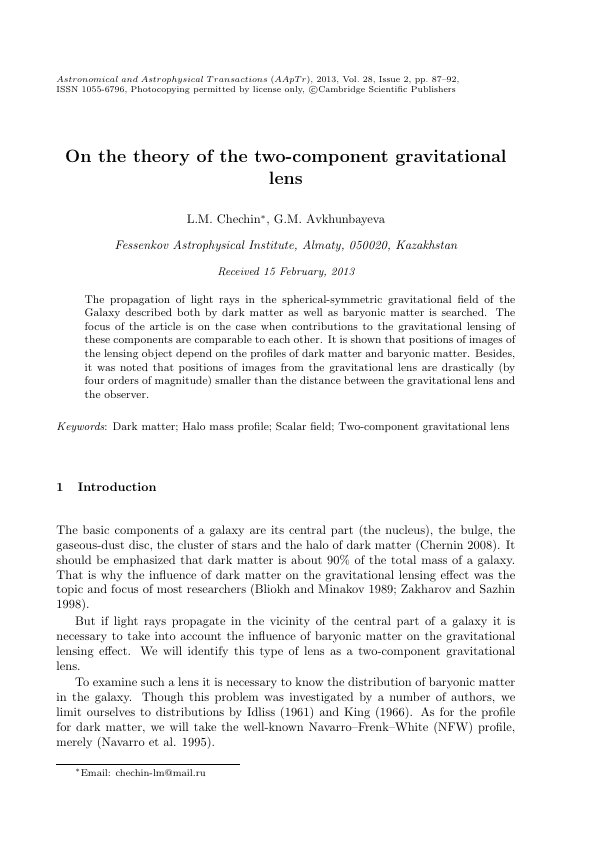
The propagation of light rays in the spherical-symmetric gravitational field of the Galaxy described both by dark matter as well as baryonic matter is searched. The focus of the article is on the case when contributions to the gravitational lensing of these components are comparable to each other. It is shown that positions of images of the lensing object depend on the profiles of dark matter and baryonic matter. Besides, it was noted that positions of images from the gravitational lens are drastically (by four orders of magnitude) smaller than the distance between the gravitational lens and the observer.
Abstract
The propagation of light rays in the spherical-symmetric gravitational field of the Galaxy described both by dark matter as well as baryonic matter is searched. The focus of the article is on the case when contributions to the gravitational lensing of these components are comparable to each other. It is shown that positions of images of the lensing object depend on the profiles of dark matter and baryonic matter. Besides, it was noted that positions of images from the gravitational lens are drastically (by four orders of magnitude) smaller than the distance between the gravitational lens and the observer.
Read the article
PDF of 6 pages, as printed in the journal, pages 87 to 92. Open access.
Read the PDF