
New discoveries of variable stars and implications for variability-type statistics
Summary
We review the changes of our understanding of classification and statistics of variable stars following from mass discoveries of variable stars in ground-based and space-borne surveys. By now, we know only a small fraction even of those stars that show moderate-amplitude (by at least 0m .02) photometric variations and almost nothing about microvariability, at the scale of 0m .0001−0m .001. Thus, our understanding of the variable-star classification is based on insufficient material, and if the classification system is revised right now, a new revision will be badly needed within years. The statistics of the existing variability types is biased in a manner not easy even to explain, and many new types emerge all the time. The future prospects of variable-star catalogs remain unclear and need attentive consideration.
Abstract
We review the changes of our understanding of classification and statistics of variable stars following from mass discoveries of variable stars in ground-based and space-borne surveys. By now, we know only a small fraction even of those stars that show moderate-amplitude (by at least 0m .02) photometric variations and almost nothing about microvariability, at the scale of 0m .0001−0m .001. Thus, our understanding of the variable-star classification is based on insufficient material, and if the classification system is revised right now, a new revision will be badly needed within years. The statistics of the existing variability types is biased in a manner not easy even to explain, and many new types emerge all the time. The future prospects of variable-star catalogs remain unclear and need attentive consideration.
Read the article
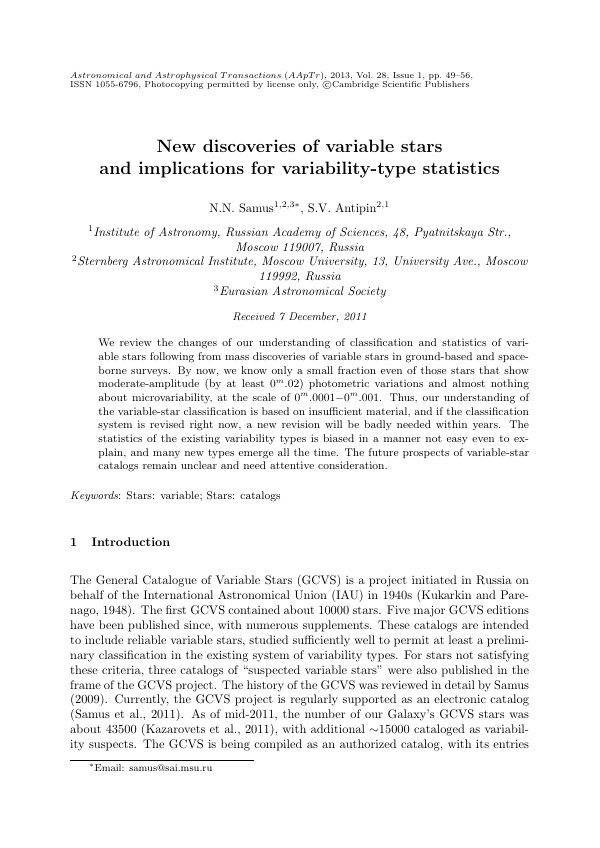
PDF of 8 pages, as printed in the journal, pages 49 to 56. Open access.
Read the PDF