
Properties of orbits in galaxy models
Summary
We consider a gravitational field in steady state galaxy models of two kinds. Some of them are axisymmetric and others are triaxial. Equipotentials and potential law are given separately in accordance to Kutuzov and Ossipkov. The relatively simple potential law is based on Kuzmin–Malasidze model. Two kinds of models contain four and five structural parameters, respectively. One composite model is suggested as well. Some examples of trajectories are calculated in these models. The simplest method to describe orbits is drawing their projections on coordinate planes. However it needs a great amount of calculation and presents problems with interpretation of information. In the case of axisymmetric models a motion in co-moving meridional plane (with cylindrical coordinates R, z) is considered as a common way. In the case of triaxial models one can use three different co-moving planes passing through moving star and corresponding coordinate axis. We describe models in Sections 2–4, calculated orbits are discussed in Section 5. Some results were presented at the Conference “Dynamics of galaxies” held at Pulkovo Observatory (August 6–10, 2007).
Abstract
We consider a gravitational field in steady state galaxy models of two kinds. Some of them are axisymmetric and others are triaxial. Equipotentials and potential law are given separately in accordance to Kutuzov and Ossipkov. The relatively simple potential law is based on Kuzmin–Malasidze model. Two kinds of models contain four and five structural parameters, respectively. One composite model is suggested as well. Some examples of trajectories are calculated in these models. The simplest method to describe orbits is drawing their projections on coordinate planes. However it needs a great amount of calculation and presents problems with interpretation of information. In the case of axisymmetric models a motion in co-moving meridional plane (with cylindrical coordinates R, z) is considered as a common way. In the case of triaxial models one can use three different co-moving planes passing through moving star and corresponding coordinate axis. We describe models in Sections 2–4, calculated orbits are discussed in Section 5. Some results were presented at the Conference “Dynamics of galaxies” held at Pulkovo Observatory (August 6–10, 2007).
Read the article
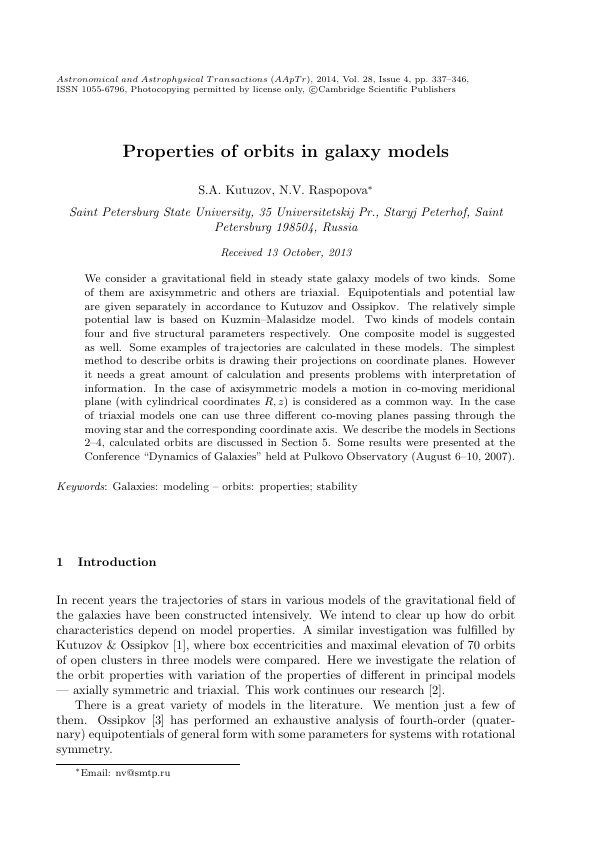
PDF of 10 pages, as printed in the journal, pages 337 to 346. Open access.
Read the PDF