
Gamma-ray bursts appear simpler than expected?
Summary
The cosmic gamma-ray bursts are certainly an enigma in astrophysics. The "standard fireball" scenario developed during many years has provided a possible explanation of this phenomenon. The aim of this work is simply to explore a new possible interpretation by developing a coherant scenario inside the global picture of stellar evolution. At the basis of our scenario is the fact that maybe we have not fully understood how the core of a pair instability supernovae explode. In such a way, we have proposed a new paradigm assuming that the core of such a massive star, instead of doing a symmetrical explosion, is completely fragmented in hot spots of burning nuclear matter. We have tested our scenario using some observational data like GRB spectrum, light curves, Amati relation and GRB-SN connection, and for each set of data we have proposed a possible physical interpretation. We have also suggested some possible tests of this scenario by measurement at high redshift. If this scenario is correct, it tells us simply that cosmic gamma-ray bursts are simply a missing link in stellar evolution.
Abstract
The cosmic gamma-ray bursts are certainly an enigma in astrophysics. The "standard fireball" scenario developed during many years has provided a possible explanation of this phenomenon. The aim of this work is simply to explore a new possible interpretation by developing a coherant scenario inside the global picture of stellar evolution. At the basis of our scenario is the fact that maybe we have not fully understood how the core of a pair instability supernovae explode. In such a way, we have proposed a new paradigm assuming that the core of such a massive star, instead of doing a symmetrical explosion, is completely fragmented in hot spots of burning nuclear matter. We have tested our scenario using some observational data like GRB spectrum, light curves, Amati relation and GRB-SN connection, and for each set of data we have proposed a possible physical interpretation. We have also suggested some possible tests of this scenario by measurement at high redshift. If this scenario is correct, it tells us simply that cosmic gamma-ray bursts are simply a missing link in stellar evolution.
Read the article
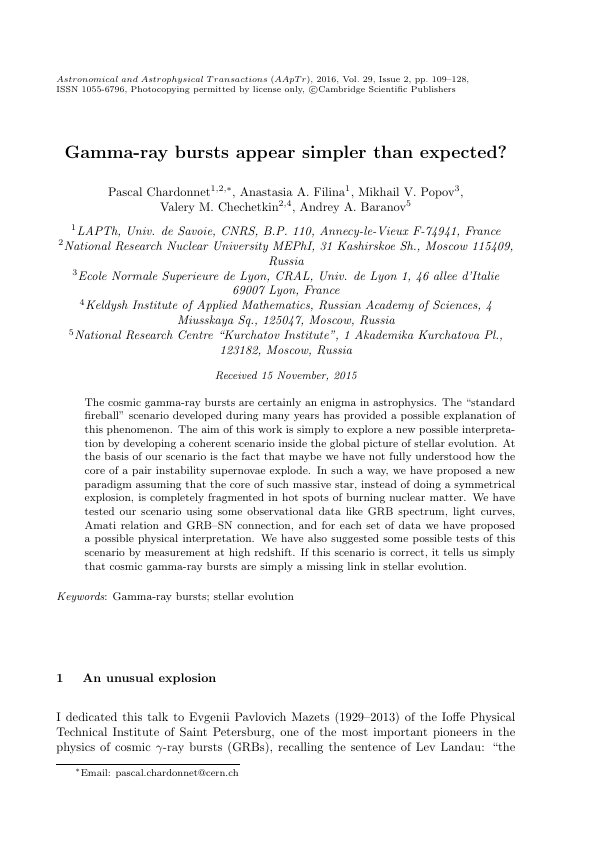
PDF of 20 pages, as printed in the journal, pages 109 to 128. Open access.
Read the PDF