
Transient dynamics of large scale vortices in Keplerian disk
Summary
The mechanism of transition from laminar state to turbulent state in Keplerian disks is still unknown. The most popular version today is generation of turbulence due to magnetorotational instability (MRI). However, magnetohydrodynamic simulations give the value of Shakura-Sunyaev parameter more than an order of magnitude smaller than that found from observations. One way to solve this problem is the existence of an alternative or additional mechanism for generating turbulence. It can be the bypass mechanism, which is responsible for transition to turbulence in Couette and Poiseuille flows. This mechanism is based on the transient growth of linear perturbations in the flow with the subsequent transition to the nonlinear stage. In order to clarify the role of this mechanism in astrophysical disks first of all it is necessary to calculate the maximal possible growth factor of linear perturbations in the flow. In this paper the results of such calculations are presented for perturbations on different scales compared with the disk thickness. Qualitative description of mechanisms responsible for the growth will also be presented. It was found that the most rapidly growing shear harmonics have azimuthal wavelength of the order of the disk thickness. In addition, their initial form is always similar to the vortex perturbations with the same potential vorticity. It was shown that the vortices with azimuthal wave-length more than an order of magnitude in excess of the disc thickness, are still able to grow by dozens of times.
Abstract
The mechanism of transition from laminar state to turbulent state in Keplerian disks is still unknown. The most popular version today is generation of turbulence due to magnetorotational instability (MRI). However, magnetohydrodynamic simulations give the value of Shakura-Sunyaev parameter more than an order of magnitude smaller than that found from observations. One way to solve this problem is the existence of an alternative or additional mechanism for generating turbulence. It can be the bypass mechanism, which is responsible for transition to turbulence in Couette and Poiseuille flows. This mechanism is based on the transient growth of linear perturbations in the flow with the subsequent transition to the nonlinear stage. In order to clarify the role of this mechanism in astrophysical disks first of all it is necessary to calculate the maximal possible growth factor of linear perturbations in the flow. In this paper the results of such calculations are presented for perturbations on different scales compared with the disk thickness. Qualitative description of mechanisms responsible for the growth will also be presented. It was found that the most rapidly growing shear harmonics have azimuthal wavelength of the order of the disk thickness. In addition, their initial form is always similar to the vortex perturbations with the same potential vorticity. It was shown that the vortices with azimuthal wave-length more than an order of magnitude in excess of the disc thickness, are still able to grow by dozens of times.
Read the article
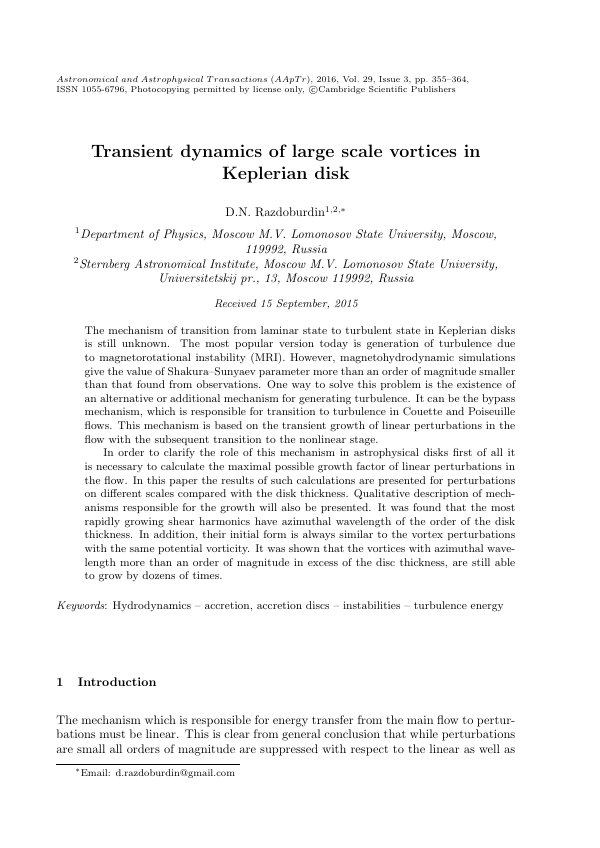
PDF of 10 pages, as printed in the journal, pages 355 to 364. Open access.
Read the PDF