
Buoyancy of magnetic fields in accretion disks
Summary
We investigate magnetic field buoyancy in accretion disks of young stars. It is assumed that magnetic flux tubes (MFTs) arise in the regions of the effective generation of the azimuthal magnetic field. Equations of the MFTs dynamics take into account aero-dynamic and turbulent drag forces. We investigate the adiabatic case. Accretion disk density, temperature and magnetic field components are calculated using the kinematic MHD-model of Dudorov and Khaibrakhmanov (2014). Numerical calculations show that rise time of the MFTs is less than the time of azimuthal magnetic field generation. Buoyancy can limit azimuthal magnetic field at the equipartition level. Rising MFTs may cause the out flows from the inner regions of accretion disks of young stars.
Abstract
We investigate magnetic field buoyancy in accretion disks of young stars. It is assumed that magnetic flux tubes (MFTs) arise in the regions of the effective generation of the azimuthal magnetic field. Equations of the MFTs dynamics take into account aero-dynamic and turbulent drag forces. We investigate the adiabatic case. Accretion disk density, temperature and magnetic field components are calculated using the kinematic MHD-model of Dudorov and Khaibrakhmanov (2014). Numerical calculations show that rise time of the MFTs is less than the time of azimuthal magnetic field generation. Buoyancy can limit azimuthal magnetic field at the equipartition level. Rising MFTs may cause the out flows from the inner regions of accretion disks of young stars.
Read the article
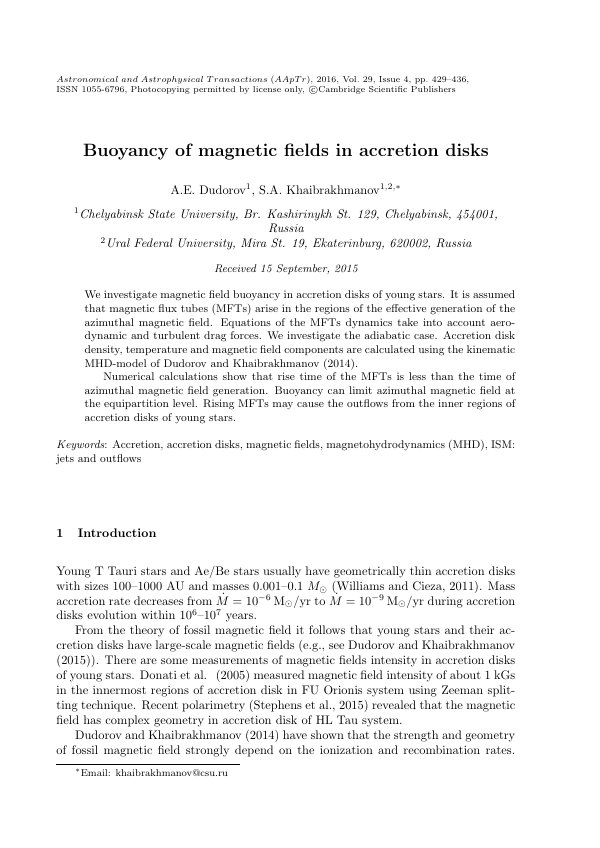
PDF of 8 pages, as printed in the journal, pages 429 to 436. Open access.
Read the PDF