
Peculiarities in emission of radio loud and radio quiet gamma pulsars and gamma quiet radio pulsars
Summary
Comparison of three pulsar samples-radio pulsars (R), gamma pulsars (gamma) and pulsars with emission in both ranges (gamma + R) has been carried out. It was shown that magnetic fields at the light cylinder are two orders of magnitude higher in gamma pulsars ((logBlc) = 3.60-3.95 G) when compared with radio pulsars ((logBlc) = 1:75 G). Losses of rotation energy in these objects differ much more (log dE=dt = 35.37-35.53 and 32.60, correspondingly). Gamma pulsars form two groups separated in space. The conclusion is made that generation of gamma emission takes place at the light cylinder and can be caused by the synchrotron mechanism.
Abstract
Comparison of three pulsar samples-radio pulsars (R), gamma pulsars (gamma) and pulsars with emission in both ranges (gamma + R) has been carried out. It was shown that magnetic fields at the light cylinder are two orders of magnitude higher in gamma pulsars ((logBlc) = 3.60-3.95 G) when compared with radio pulsars ((logBlc) = 1:75 G). Losses of rotation energy in these objects differ much more (log dE=dt = 35.37-35.53 and 32.60, correspondingly). Gamma pulsars form two groups separated in space. The conclusion is made that generation of gamma emission takes place at the light cylinder and can be caused by the synchrotron mechanism.
Read the article
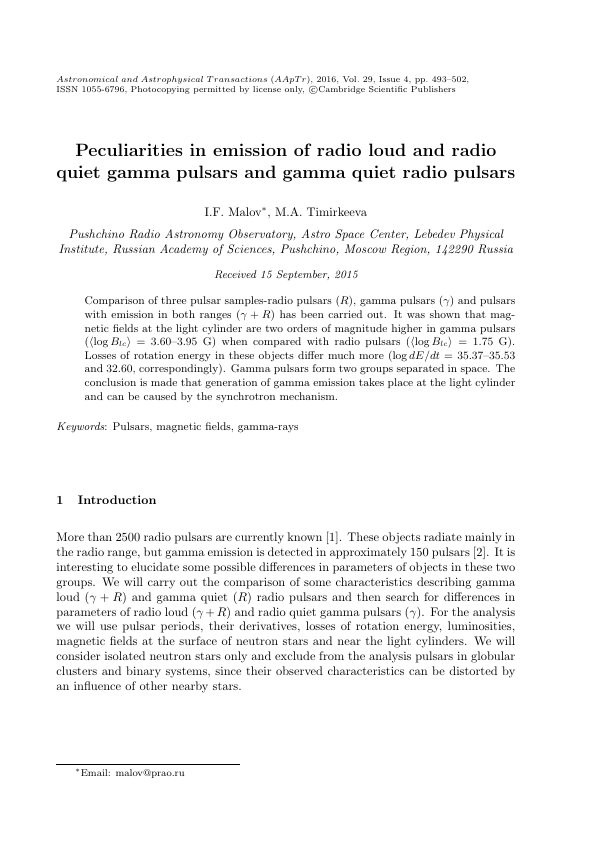
PDF of 10 pages, as printed in the journal, pages 493 to 502. Open access.
Read the PDF