
Galaxy origin: the first billion years of the Universe
- Sternberg Astronomical Institute of the Lomonosov Moscow State University, University av. 13, Moscow 119234, Russia
Abstract
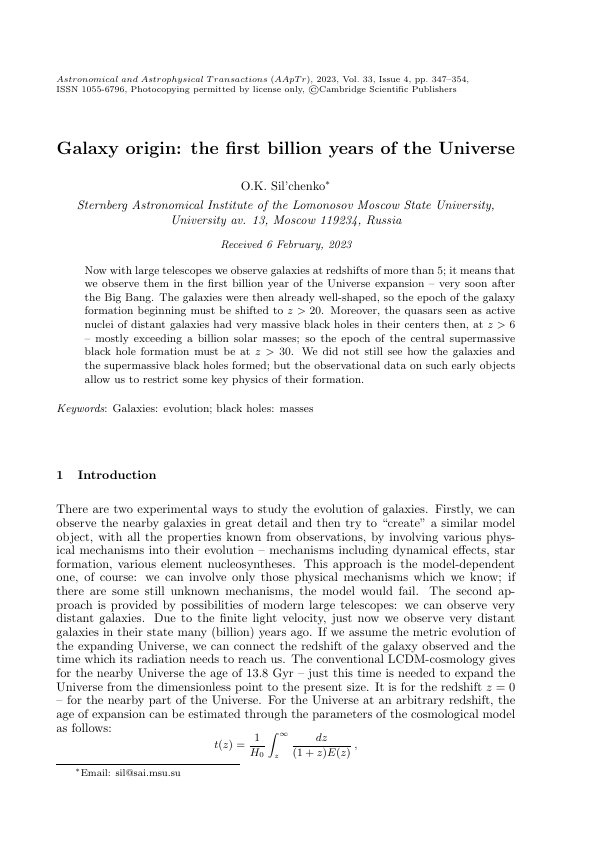
Now with large telescopes we observe galaxies at redshifts of more than 5; it means that we observe them in the first billion years of the Universe expansion -- very soon after
the Big Bang. The galaxies were then already well-shaped, so the epoch of the galaxy
formation beginning must be shifted to z > 20. Moreover, the quasars seen as active
nuclei of distant galaxies had very massive black holes in their centers then, at z > 6 -- mostly exceeding a billion solar masses; so the epoch of the central supermassive
black hole formation must be at z > 30. We did not still see how the galaxies and the supermassive black holes formed; but the observational data on such early objects
allow us to restrict some key physics of their formation.
Read the article
PDF of 8 pages, as printed in the journal, pages 347 to 354. Open access.
Read the PDF