
Local and global dynamical effects of dark energy
Summary
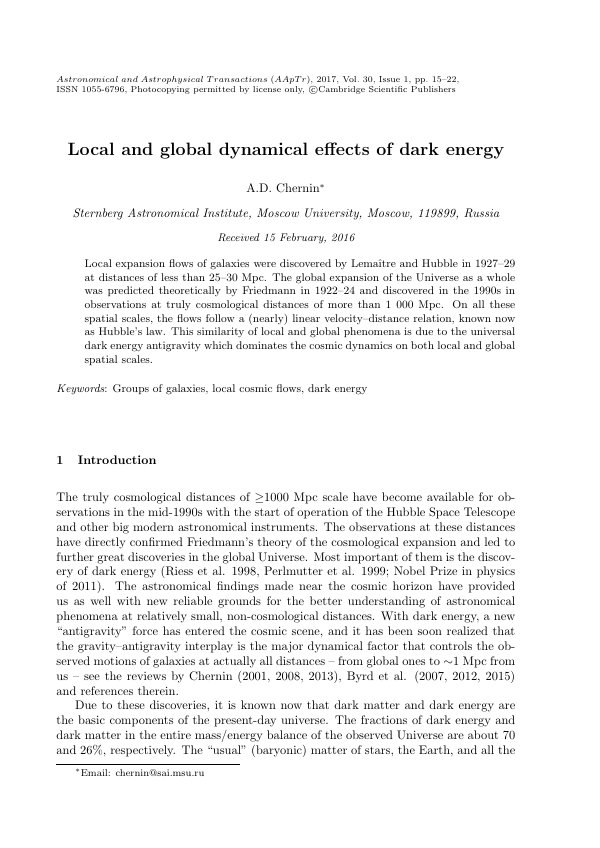
Local expansion flows of galaxies were discovered by LeMaitre and Hubble in 1927-29 at distances of less than 25-30 Mpc. The global expansion of the Universe as a whole was predicted theoretically by Friedmann in 1922-24 and in 1990s in observations at truly cosmological distances of more than 1 000 Mpc. On all these spatial scales, the flows follow a (nearly) linear velocity-distance relation, known now as Hubble's law. This similarity of local and global phenomena is due to the universal dark energy antigravity which dominates the cosmic dynamics on both local and global spatial scales.
Abstract
Local expansion flows of galaxies were discovered by LeMaitre and Hubble in 1927-29 at distances of less than 25-30 Mpc. The global expansion of the Universe as a whole was predicted theoretically by Friedmann in 1922-24 and in 1990s in observations at truly cosmological distances of more than 1 000 Mpc. On all these spatial scales, the flows follow a (nearly) linear velocity-distance relation, known now as Hubble's law. This similarity of local and global phenomena is due to the universal dark energy antigravity which dominates the cosmic dynamics on both local and global spatial scales.
Read the article
PDF of 8 pages, as printed in the journal, pages 15 to 22. Open access.
Read the PDF