
Big Bang as a result of the curvature-driven first-order phase transition in the early cold Universe
Summary
We suggest that the "Big Bang" may be a result of the first-order phase transition
driven by changing scalar curvature of the 4D space-time in the expanding cold Universe,filled with nonlinear scalar field and neutral matter with equation of state
p = " (where p and " are pressure and energy density of matter). Given certain
conditions the critical radius of the early Universe at the point of the first-order phase transition may reach arbitrary large values, so this scenario of unrestricted
"inflation" of the Universe may be called "hyperinflation". Beyond the point of phase transition the system is rolling down into the potential minimum releasing the potential energy of scalar field with subsequent powerful heating of the Universe playing the role of "Big Bang".
Abstract
We suggest that the "Big Bang" may be a result of the first-order phase transition
driven by changing scalar curvature of the 4D space-time in the expanding cold Universe,filled with nonlinear scalar field and neutral matter with equation of state
p = " (where p and " are pressure and energy density of matter). Given certain
conditions the critical radius of the early Universe at the point of the first-order phase transition may reach arbitrary large values, so this scenario of unrestricted
"inflation" of the Universe may be called "hyperinflation". Beyond the point of phase transition the system is rolling down into the potential minimum releasing the potential energy of scalar field with subsequent powerful heating of the Universe playing the role of "Big Bang".
Read the article
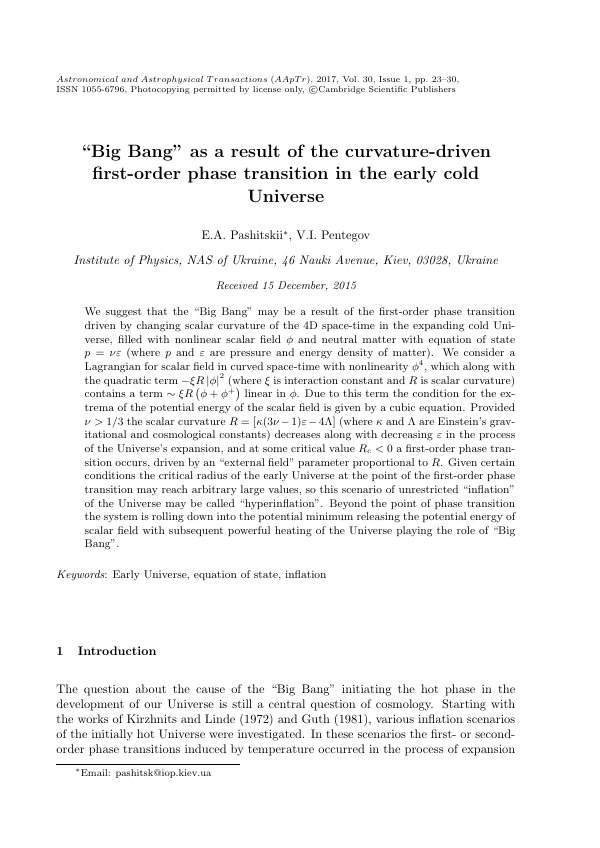
PDF of 8 pages, as printed in the journal, pages 23 to 30. Open access.
Read the PDF